
The Pool Is Finished. Why Does the Project Still Look Incomplete After Dark?
The pool is usually the centerpiece
It establishes the shape of the backyard, influences the patio layout, and gives every surrounding feature a point of reference. Decking, walls, plantings, steps, kitchens, pergolas, and gathering areas are all designed around it. Then the project is viewed after sunset. The water is illuminated, but the landscape behind it disappears. The patio feels disconnected from the home. Steps and grade changes are difficult to read. A bright fixture reflects across the pool while the outdoor kitchen sits in a dark corner.
Technically, the pool is lit. The project is not. Pool lighting and pool-area lighting are related, but they are not the same thing. A complete nighttime environment requires someone to consider the water, hardscape, landscape, architecture, circulation, and primary views as one connected design.

Lighting the Pool Is Not the Same as Lighting the Project
Underwater fixtures give the pool color, movement, definition
They make the water visible and help establish it as the center of the space. But they cannot do every job. They do not explain how guests should move from the home to the patio. They do not reveal a change in grade, bring texture out of a stone wall, illuminate a cooking surface, or connect the edge of the pool to the surrounding landscape.
That broader work belongs to the landscape lighting design.
A successful design considers how the entire environment functions after dark:
Where people enter the space
How they move between the home, pool, and outdoor rooms
Which steps and transitions require visibility
Where people gather, cook, dine, and relax
Which landscape features give the project depth
How the water reflects nearby light
Which views should remain open
Where darkness should be preserved
The pool may be the centerpiece, but it still needs a setting.
The Best Time to Coordinate Lighting Is Before the Hard Surfaces Are Finished
Landscape lighting is sometimes discussed after the pool is filled, the decking is installed, and the landscape crews are nearly finished. By then, the easy options may already be gone. Finished pavers, concrete, coping, retaining walls, and planting beds can limit wiring routes or fixture locations that would have been straightforward earlier in the project. The lighting can still be added, but the team may be working around decisions that are already permanent.
An early conversation can help identify:
Likely wiring paths
Areas where future access may become difficult
Steps, walls, and transitions that need lighting
Locations where fixtures can remain concealed
Features that require coordination before masonry or decking is complete
Outdoor rooms that need separate lighting zones
Views across the pool that must remain free of glare
Installation timing that helps protect finished work
Light Your Nights does not need to direct the pool construction. We need enough visibility into the project to design around it. The earlier we understand the layout, materials, grade changes, and surrounding features, the more effectively the lighting can support the finished space.
Water Changes the Way Light Behaves
Water is not a passive surface
It reflects bright fixtures, illuminated architecture, trees, and nearby structures. It can strengthen a well-controlled composition—or broadcast one poorly aimed light across the entire backyard. That is why fixture placement around a pool requires restraint.
A light that appears subtle from the patio may produce distracting glare when seen across the water. A brightly illuminated tree may create a strong reflection that competes with the pool itself. Lighting along the far edge can make the space feel deeper, but too much can flatten the entire view. The goal is not to eliminate reflection. Reflection can add movement and visual interest.
The goal is to control what the water reflects:
Glare Can Undermine an Otherwise Beautiful Project
Pool environments are viewed from several directions:
From inside the home
Across the patio
From lounge and dining areas
From within the pool
From an outdoor kitchen or pergola
From a lake-facing terrace or shoreline
A fixture concealed from one viewpoint may be painfully visible from another. Glare is especially noticeable around water because the eye is already drawn toward the reflective surface. One exposed source can become the brightest object in the entire composition.
Good pool landscape lighting considers the important viewpoints before final placement and aiming. Fixtures should do their job without announcing where they are. The result should direct attention toward the pool, architecture, landscape, and people using the space, not toward a row of bright lamps.
Light the Transitions, Not Every Edge
There is a temptation to outline the entire pool area
Every edge gets a fixture. Every step gets equal emphasis. Path lights are spaced at predictable intervals, and walls become continuous bands of light. The result may be visible, but it rarely feels designed. Transitions deserve more attention than outlines. Lighting can help people understand where the patio ends, where the lawn begins, how to approach a set of steps, and how one outdoor room connects to another. It can reveal a change in elevation without turning the pool deck into an airport runway.
Selective lighting also allows the pool to remain the visual center. The eye should move naturally from the home to the gathering space, across the water, and into the surrounding landscape. It should not bounce between dozens of equally bright points.
Connect the Pool to the Spaces Around It
Homeowners are often building complete outdoor environments including:
Covered patios
Outdoor kitchens
Dining areas
Pergolas or pavilions
Fire features
Retaining walls
Lawn and garden areas
Paths toward the lake
Seating areas away from the main patio
Each space has a different lighting requirement. A grill and preparation surface need practical task lighting. A dining area needs enough illumination to remain useful without feeling harsh. Steps and walkways need clear transitions. Landscape features need depth and selective emphasis. Those needs should feel connected rather than assembled as separate systems. For pool professionals, the larger question comes earlier: how should those areas be coordinated with the pool before construction is complete?
A pool, kitchen, and pergola may serve different purposes but they should still read as one project.
The Landscape Gives the Pool Its Nighttime Setting
During the day, the surrounding landscape provides color, screening, texture, scale, privacy
At night, much of that can disappear unless it is deliberately brought into the composition. The answer is not to illuminate every tree and planting bed. A few carefully selected features can give the pool area depth beyond the deck. Trees can establish height. Plantings can soften walls and structures. A controlled layer of light at the edge of the space can prevent the pool from appearing suspended in a black background.
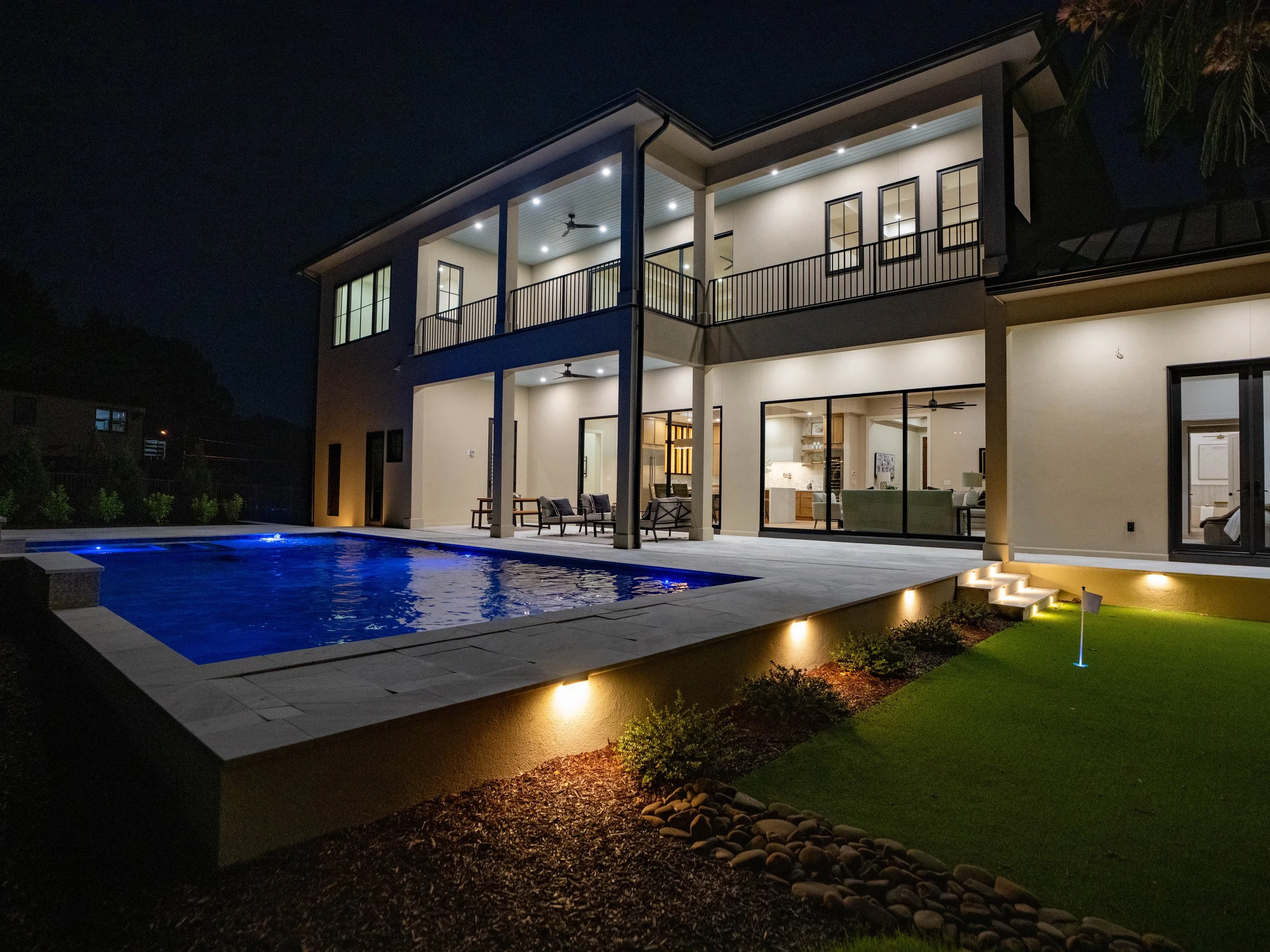
The landscape should support the pool without competing with it. A Lake Norman LYN project shows how the pool, patio, stonework, mature trees, walking areas, and shoreline can remain connected without flooding the entire setting with light. See the completed backyard lighting design from patio to shoreline.
The project works because the lighting has a purpose. The water remains important, but it is no longer carrying the entire backyard on its back.
Lakefront Projects Require More Restraint, Not More Light
On Lake Norman, the water beyond the pool may be one of the project’s most valuable views
Landscape lighting should not erase it. Excessive brightness near the shoreline, strong reflections, or poorly shielded fixtures can make the lake harder to see from the home and patio. The foreground becomes so bright that everything beyond it recedes into darkness. A more restrained approach preserves the relationship between the pool and the larger waterfront setting.
That may mean:
Keeping shoreline lighting subtle
Directing light away from the water
Avoiding visible sources across major sightlines
Using landscape lighting to frame rather than overpower the view
Allowing portions of the property to remain naturally dark
Separating pool, patio, landscape, and shoreline areas into useful zones
The best lighting understands when the lake should be allowed to do some of the work.
Clarify Responsibilities Before the Final Walkthrough
A completed pool environment can involve several professionals:
Pool builder
Landscape designer
Hardscape contractor
Electrician
Outdoor kitchen contractor
Pergola or pavilion builder
Irrigation contractor
Landscape lighting designer
Lighting problems often begin when everyone assumes someone else is handling a particular area. The pool builder may include underwater fixtures but not the surrounding landscape. The electrician may provide power but not determine how the site should be composed after dark. A kitchen contractor may install decorative fixtures without addressing the steps leading to the space.
Early coordination helps clarify
Which lighting is part of the pool
Which lighting belongs to surrounding structures
Who is responsible for the landscape lighting
When installation should occur
How controls and zones will be organized
Who will complete final aiming and adjustments
That clarity makes the final project easier to manage and easier to explain to the client.
Protect the Work That Is Already Finished
By the time a pool project reaches its final stages, a great deal of expensive work may already be complete
The decking is finished. Coping is installed. Walls are capped. Plantings are in place. Irrigation is operating. The lawn has been repaired, and nobody wants to reopen it. Thoughtful installation planning helps reduce unnecessary disruption to those surfaces and systems. Light Your Night’s landscape lighting installation process focuses on careful fixture placement, professional-grade components, and a finished system designed around the site.
But the cleanest installation begins before every possible route has been covered by concrete, stone, roots, or a very expensive outdoor kitchen. A ten-minute lighting conversation early in the project is generally more productive than an hour spent staring at newly installed pavers and discussing what can still be done.
Better Lighting Helps the Entire Project Show Better
Pool builders and designers depend on completed projects to demonstrate the quality of their work
Daytime photography shows materials, water color, layout, craftsmanship, and the relationship between the pool and the home. Nighttime photography can reveal an entirely different side of the same project.
It can show:
How the pool anchors the outdoor environment
How the patio remains useful after sunset
How stone, walls, and structures gain texture
How the landscape creates depth
How movement through the space feels natural
How the project connects to the lake or surrounding setting
A pool that photographs beautifully during the day but disappears into darkness at night is only telling half the story. Lighting does not replace the pool design. It gives that design more hours to be seen.
A Lighting Partner for the Space Beyond the Water
Pool builders should not have to become landscape lighting designers
Your expertise belongs in the pool’s engineering, construction, materials, hydraulics, finishes, and overall integration with the site. LYN’s role is to consider what happens beyond the water. We look at how people enter the space, how the pool relates to the home, where glare may develop, which landscape features deserve emphasis, and how the surrounding outdoor rooms should function after dark.
We can coordinate directly with your team or work separately with the homeowner while respecting the design, schedule, and responsibilities already established for the project. Our broader Professional Collaboration approach is built around bringing lighting into the conversation while there is still time to make thoughtful choices.
Bring Light Your Nights Into the Pool Project Early
The pool should remain the centerpiece after sunset
It should not be the only part of the project anyone can see. Light Your Nights works with pool builders, designers, project professionals, and homeowners throughout Lake Norman, Cornelius, Mooresville, Davidson, Huntersville, and the greater Charlotte area.
Contact Light Your Nights to discuss an upcoming pool project before the decking, landscaping, and outdoor living construction are complete. Let’s make the entire project look finished after dark—not just the water.
Ready to discuss an upcoming project?
Let’s make sure your landscape still looks like your landscape after dark.